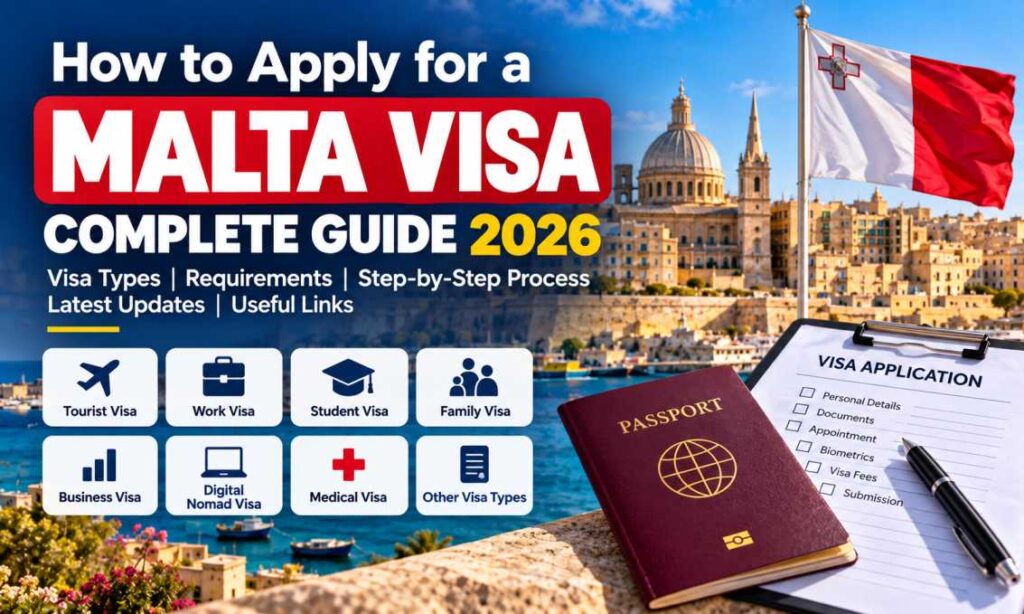
Malta is a European Union and Schengen Area country that attracts visitors, international students, workers, digital nomads, entrepreneurs and families from around the world.
For non-EU, non-EEA and non-Swiss nationals, the correct immigration route depends mainly on why you want to travel to Malta and how long you intend to stay.
Malta generally uses two main visa categories:
- Schengen Type C visa – for short stays of up to 90 days in any 180-day period.
- National Type D visa – for longer stays in Malta, generally exceeding 90 days and up to 365 days under the national visa framework.
The correct application route is important. A tourist visa, for example, does not give you the right to move to Malta permanently, work or start a long-term course.
This guide explains the major Malta visa categories, how to apply, important documents, work and study routes, family reunification, digital nomad options and important immigration changes applicants should know in 2026.
Malta Visa: What You Need to Know First
Before applying, determine whether you actually need a visa.
Some nationalities can enter the Schengen Area without a visa for short visits of up to 90 days in any 180-day period. Other nationalities must obtain a Schengen visa before travelling.
Malta’s official immigration authority, Identità, provides information on visa-required and visa-exempt nationalities.
Check Malta’s official visa requirements
If you are planning to stay in Malta for more than 90 days, you generally need to look at a National D visa and/or a Maltese residence permit, depending on the purpose of your stay.
Types of Malta Visas
Malta’s visa system covers several purposes. The appropriate category depends on the reason for your trip.
The main categories include:
Schengen Type C Visa
This is the short-stay visa for visits of no more than 90 days within a 180-day period.
It can cover purposes such as:
- Tourism
- Visiting family or friends
- Business
- Cultural activities
- Sports activities
- Medical treatment
- Official visits
- Short-term study
- Airport transit
A Schengen visa issued by Malta can also allow travel within the Schengen Area, subject to the conditions and validity of the visa.
Malta Schengen Visa information
Tourist Visa
If you want to visit Malta for tourism and you are from a visa-required country, you generally apply for a Schengen Type C visa.
You will normally need to demonstrate the purpose of your trip, accommodation, financial means, travel arrangements and other requirements applicable to your application.
A tourist visa is for a temporary visit. It should not be used as a way to enter Malta with the intention of working or beginning a long-term course.
Business Visa
A business visitor may use a Schengen Type C visa for qualifying short-term business activities.
Examples can include meetings, conferences, business discussions and other permitted temporary activities.
For business stays exceeding 90 days, Malta also has a National D visa category for professional/business purposes, subject to the applicable requirements.
Malta National Visa application categories
Family or Friends Visit Visa
If you are visiting relatives or friends in Malta for a short period, you may apply for a Schengen Type C visa if your nationality requires one.
You may be required to provide evidence of your relationship or invitation, accommodation, finances, travel arrangements and other supporting documentation.
If your intention is to move to Malta to live with a family member, however, a normal visitor visa is generally not the appropriate immigration route. You may instead need to investigate family reunification or a family-member residence route.
Medical Visa
Applicants travelling to Malta for qualifying medical treatment can apply under the relevant medical visa category.
Medical visa applications normally require documentation relating to the medical treatment, the Maltese medical institution or provider, financial arrangements, accommodation and insurance, depending on the circumstances.
Official Malta visa categories and document checklists
Airport Transit Visa
An airport transit visa is intended for certain travellers who need to transit through a Maltese or other Schengen airport without entering the Schengen territory.
Whether you need an airport transit visa depends on your nationality, itinerary and circumstances.
An airport transit visa is different from a normal visitor visa because it does not generally give you permission to enter Malta for tourism.
Malta Schengen Visa information
Student Visa
International students planning to study in Malta need to pay close attention to the length and level of their course.
For courses exceeding 90 days, Malta uses the National Long-Stay D visa framework. Identità specifically states that students, including visa-exempt nationals, undertaking courses exceeding 90 days must obtain the appropriate National D visa before travelling where applicable.
Identità’s current guidance states that students taking courses of 105 days or more should apply for a Study D visa before travelling.
For D-visa study applications, the current guidance recommends submitting the application at least eight weeks before the course begins, while applications can generally be submitted up to six months before the course commencement date.
Malta Student D Visa information
Official Student National Visa document checklist
Short Courses in Malta
Students attending courses that do not exceed 90 days may generally use the applicable short-stay arrangements.
Identità states that third-country nationals attending courses lasting no more than 90 days may be issued a Schengen Type C visa, where a visa is required.
However, applicants should check the exact course duration and their nationality before applying.
Work Visa and Work Permit
Malta does not simply issue a general “job seeker visa” to anyone who wants to look for employment.
For most non-EU nationals seeking long-term employment, the normal process begins with securing an eligible job offer from a Maltese employer.
The employer then generally applies for the Single Permit, which combines authorization for employment and residence.
Identità states that third-country nationals who receive a job offer from a company registered and operating in Malta can be eligible for a Single Permit, and the prospective employer normally submits the application on the worker’s behalf.
Malta Single Permit official information
How the Malta Work Visa Process Works
For a typical overseas worker, the process can look like this:
- Find a genuine job with a Maltese employer.
- Receive a formal employment offer or contract.
- The employer starts the Single Permit application.
- Complete any required pre-departure and sector-specific requirements.
- Wait for the relevant approval.
- If you are a visa-required national and the application is approved in principle, apply for the appropriate National D visa.
- Travel to Malta after receiving the necessary authorization.
- Complete the required biometrics and residence-permit procedures.
A Single Permit is tied to the employment conditions approved by Identità. It does not automatically allow a worker to take another job or work for another employer.
Major Malta Work Immigration Update for 2026: Pre-Departure Course
One of the most important changes for people planning to work in Malta is the introduction of the Pre-Departure Course.
Malta introduced the course for first-time third-country national Single Permit applicants.
The course includes training relating to living and working in Malta, workplace rights and obligations, English-language assessment and cultural awareness.
Identità began formally verifying the certificate from 1 March 2026 for applicable new and still-abroad applications.
The current Identità information states that the Pre-Departure Course costs €250.
Malta Pre-Departure Course information
Tourism and Hospitality Workers
People planning to work in Malta’s tourism and hospitality sector should pay particular attention to the additional requirements.
Identità states that applicants in the tourism and hospitality sector may need both the Pre-Departure Course Certificate and the applicable Tourism & Hospitality Skills Pass certification.
This is particularly relevant to workers applying for jobs such as hospitality, hotel, food service and related positions.
Applicants should not assume that receiving a job offer automatically means they can travel and start working. The required employment and immigration authorizations must be completed.
New Health-Screening Rules for Workers
Another important 2026 development concerns health screening.
From 4 May 2026, Identità introduced a new automated health-screening process for work-permit applications.
The authority states that paper-based health screenings are no longer accepted for new applications, renewals or changes of employment under the new process.
The updated procedure applies to third-country nationals, including workers from countries previously considered low-risk for tuberculosis in the relevant screening framework.
This means workers should carefully follow the current health-screening instructions rather than relying on older information circulating online.
Single Permit Fees
Identità currently lists:
- First-time Single Permit: €600
- Single Permit renewal: €150 per year
These are permit fees and do not necessarily represent the total cost of an immigration process because applicants may also have visa, service, document, insurance, travel and other costs.
Student Work Rights
International students should also understand that studying in Malta and working in Malta are not the same thing.
Identità states that certain full-time students can work for a maximum of 20 hours per week, subject to the applicable rules and work authorization.
For qualifying higher-education students, the possibility of working can begin during the first year of study, subject to the relevant requirements.
Students should not assume that a student residence permit automatically gives unrestricted full-time work rights.
Post-Study Options
Some international students may be eligible for a post-study residence route allowing them to remain in Malta for a period to look for employment after completing their studies.
Identità’s current guidance states that a nine-month post-study permit can allow eligible graduates to remain in Malta to seek employment, but it is not itself a work permit.
Once a graduate receives a job offer, the employer must normally apply for the appropriate work authorization, such as a Single Permit.
Family Reunification Visa
Malta has a family reunification route for certain non-EU residents who are already legally residing in Malta.
Under the standard family reunification route, the sponsor must meet specific conditions. Current Identità guidance states that the sponsor generally needs to have held a valid residence permit and resided legally and continuously in Malta for at least two years, in addition to demonstrating adequate income, accommodation and health insurance.
Eligible family members can include a spouse and minor children, subject to the applicable rules.
Malta Family Reunification information
If the application is approved, visa-required family members normally use the approval-in-principle documentation to apply for a National D visa before travelling to Malta.
Family Members of EU Citizens
There is a separate route for qualifying family members of EU nationals.
Identità states that spouses and direct children of a Maltese or EU national who meets the applicable conditions can qualify for the relevant family-member visa route.
The rules are different from ordinary family reunification for non-EU residents, so applicants should use the correct category.
Official Malta Family Member of EU Visa information
Digital Nomad Visa
Malta also has a Nomad Residence Permit for eligible third-country nationals who work remotely for foreign employers, businesses or clients.
The current eligibility rules require applicants to be at least 18, be third-country nationals and demonstrate that they can work remotely using telecommunications technology.
Applicants must fall into an eligible category such as:
- Working for an employer registered outside Malta.
- Operating a business for a foreign company in which they are a partner or shareholder.
- Providing freelance or consulting services to clients established outside Malta.
The current minimum gross annual income requirement is €42,000.
Applicants also need appropriate health insurance, accommodation, a police conduct certificate and must pass the required background checks.
Malta Nomad Residence Permit official website
Malta Permanent Residence Programme
Malta also operates the Malta Permanent Residence Programme (MPRP), which is a separate residence programme administered by Residency Malta Agency.
This is not the same as a normal tourist, student or employment visa.
Applicants considering the MPRP should review the programme’s current eligibility, property, contribution and due-diligence requirements directly with Residency Malta Agency.
If an applicant has received the relevant approval-in-principle documentation, Identità provides a process for applying for the appropriate D visa.
Residency Malta Agency – MPRP information
Other National D Visa Categories
Malta’s National D visa system includes several additional purposes.
Depending on the circumstances and applicable requirements, these can include:
- Employment
- Student/education
- Family reunification
- Family member of an EU national
- Professional or business activities
- Scientific research
- Training
- Religious activities
- Medical reasons
- Humanitarian purposes
- Cultural activities
- Sports activities
- Official visits
- Temporary employment
- Long-term visits/non-tourism
- Voluntary work
- Working holidays
- Adoption
- Court-related purposes
- Diplomatic purposes
- Sports trials
The official D-visa application form lists these purposes, while Identità publishes separate document checklists for many of the categories.
Applicants should always use the category that accurately reflects the actual purpose of their trip.
How to Apply for a Malta Schengen Visa
If you are applying for a short stay of up to 90 days, the basic process is:
Step 1: Determine whether you need a visa
Check whether your nationality requires a Schengen visa.
Malta visa requirements by nationality
Step 2: Make sure Malta is the correct country to apply to
If you are travelling to multiple Schengen countries, Malta should generally be the country responsible for assessing your application when Malta is your main destination under the applicable Schengen rules.
If another Schengen country is actually your main destination, you may need to apply through that country’s visa system instead.
Step 3: Identify the correct visa purpose
Select tourism, business, visiting family/friends, medical treatment, study, sports, cultural activity or another appropriate purpose.
Step 4: Prepare your documents
Typical documents can include:
- Valid passport
- Completed visa application form
- Passport photograph
- Travel itinerary
- Proof of accommodation
- Travel medical insurance
- Proof of sufficient funds
- Employment or business evidence
- Evidence of ties to your country of residence
- Invitation documents where applicable
- Supporting documents explaining the purpose of the trip
The exact requirements vary according to the purpose of travel and the country where you apply.
Step 5: Book your appointment
Applications are submitted through the appropriate Maltese diplomatic mission, representation or authorized external visa service provider.
Step 6: Attend the appointment
You may be required to provide fingerprints, photograph and supporting documents.
Step 7: Wait for a decision
Identità states that Schengen applications are normally reviewed within 7 to 15 days, although individual cases requiring further scrutiny can take up to 45 calendar days after the application has been considered admissible.
Applicants should therefore avoid leaving their application until the last minute.
How to Apply for a Malta D Visa
For long-term stays, the process is different.
Malta’s current system processes National D visa applications through the Central Visa Unit and VFS Global network.
The general process is:
- Identify the appropriate D-visa category.
- Obtain the required supporting documentation.
- Where necessary, obtain prior approval from another Maltese authority.
- Complete the National D visa application.
- Book a VFS appointment through the applicable service.
- Attend the appointment and submit your documents and biometrics.
- Pay the applicable visa and service fees.
- Wait for the decision.
- Travel to Malta once the visa is issued.
- Complete any residence-permit or biometric requirements after arrival.
Identità currently states that the D-visa process may take up to eight weeks from the date of the VFS appointment.
Malta D-Visa / VFS Extended Service locations and appointments
Can I Apply for a Malta D Visa From Another Country?
Yes, under Malta’s current Extended Service arrangement, applicants can submit D-visa applications in countries where the VFS service is available, even if they are not legal residents of that country, subject to the applicable requirements.
Identità states that applicants can use the Extended Service in another country if the service is available there, but they must comply with the legal requirements for lodging the application in that country.
For example, Identità currently lists a Malta Visa Application Centre in Nairobi, Kenya among its Extended Service locations.
See Malta’s current VFS Extended Service locations
Malta D Visa Fees
There is no single universal D-visa fee because the amount can depend on the purpose of the visa and the applicant’s age category.
Identità publishes separate checklists showing the applicable fees for individual visa categories.
Applicants using the Extended Service may also face a VFS administration/service fee. Identità’s current FAQ states that the Extended Service may involve an additional VFS administration fee of approximately €150 per application.
Official Malta visa fees and document checklists
How Early Can You Apply for a Malta Schengen Visa?
A Schengen visa application may generally be lodged up to six months before the intended visit, subject to the applicable rules.
Identità advises applicants not to leave the application too late because processing can take longer where additional scrutiny is required.
Can I Extend a Malta Tourist Visa While in Malta?
Applicants should not assume that a tourist stay can simply be extended because they want to remain longer.
Identità states that tourist stays cannot generally be extended for ordinary tourism purposes while in Malta. Applicants should respect their visa validity or visa-free allowance and leave the Schengen Area when required.
Extensions can be considered in specific justified circumstances, but these are handled on a case-by-case basis.
Can I Work in Malta With a Tourist Visa?
No.
A tourist or ordinary short-stay visa does not automatically authorize employment in Malta.
If you want to work, you need to use the appropriate employment immigration route, such as the Single Permit or another applicable employment authorization.
Non-EU nationals generally require a residence permit to work legally in Malta.
Can I Change From a Tourist Visa to a Work Permit?
Do not travel to Malta as a tourist with the assumption that you can simply convert your visit into a work permit.
Employment applications are subject to specific eligibility rules, and the Single Permit application is normally submitted by the prospective employer.
The timing and procedure can also depend on whether the applicant is abroad or legally present in Malta.
Important Malta Immigration Updates in 2026
Applicants should be aware of several major developments:
1. Pre-Departure Course
First-time Single Permit applicants are subject to the new Pre-Departure Course requirements where applicable, with certificates being verified from 1 March 2026.
2. Tourism and Hospitality Skills Pass
Applicants seeking employment in tourism and hospitality may need the required Skills Pass certification in addition to the applicable pre-departure requirements.
3. New Health Screening System
From 4 May 2026, work-permit health screening moved to an automated process, and paper-based submissions are no longer accepted under the new procedure.
4. Student D Visa Requirements
Students undertaking longer courses must carefully follow the National D visa requirements before travelling, including the current recommended application timeline.
5. Digital Nomad Income Requirement
The current Nomad Residence Permit requires a minimum gross annual income of €42,000, alongside other eligibility requirements.
6. Family Reunification Requirements
Standard family reunification has specific sponsor requirements, including the current two-year legal residence condition and financial, accommodation and insurance requirements.
Documents You Should Prepare
The exact document list depends on your visa type, but applicants should generally prepare:
- Valid passport
- Completed application form
- Recent passport photograph
- Proof of accommodation
- Travel itinerary
- Travel medical insurance
- Proof of sufficient funds
- Bank statements
- Employment evidence
- Payslips where applicable
- Invitation letter where applicable
- Admission letter for students
- Employment contract for workers
- Approval-in-principle documentation where required
- Marriage or birth certificates for family applications
- Police clearance where required
- Academic documents for students
- Professional licences where applicable
- Certified translations/legalisation where required
Do not rely on an old checklist found on a blog or social-media post. Identità publishes category-specific checklists and these can be updated.
Official Malta visa document checklists
Travel Insurance Requirement
For relevant Schengen visa applications, applicants generally need travel medical insurance covering the Schengen Area.
Certain Malta D-visa categories also require specific insurance coverage.
For example, the official family reunification checklist specifies medical and travel insurance valid for the Schengen Area with minimum medical coverage of €30,000.
Applicants should always follow the insurance requirements listed on the checklist for their specific visa.
What Happens After Your Malta Visa Is Approved?
Receiving a visa does not automatically guarantee entry into Malta.
Identità states that a visa is an authorization to stay in or travel through Malta for a specified period, but border authorities can still assess whether the traveller satisfies the conditions of entry.
Travellers may be asked to demonstrate:
- The purpose of their trip.
- Where they will stay.
- Sufficient financial means.
- Valid travel documentation.
- Compliance with the conditions of their visa.
Always carry important supporting documents when travelling.
Malta Visa Rejection: What Should You Do?
A visa refusal does not necessarily mean you can never travel to Malta.
The first step is to read the refusal decision carefully and identify the reason for refusal.
Possible concerns in a visa application can include:
- Insufficient evidence of the purpose of travel.
- Inadequate financial evidence.
- Unclear accommodation arrangements.
- Inconsistent information.
- Concerns about the applicant’s intention to leave after a short visit.
- Missing documentation.
- Invalid or insufficient insurance.
- Questions about the authenticity of submitted documents.
If you apply again, address the actual weaknesses identified in the refusal rather than simply submitting the same application again.
Where an appeal is available, follow the instructions and deadline stated in the refusal decision.
Malta Visa Application: Official Links
For applicants, these are some of the most useful official resources:
Malta Central Visa Unit
Visit the Malta Central Visa Unit
Malta Schengen Visa
Malta Schengen Visa information
Malta Visa Requirements
Malta Visa Application / Online Services
Official Malta visa application information
Malta D Visa and VFS Extended Service
Find a Malta D-visa VFS location and appointment information
Malta Visa Fees and Checklists
Official visa fees and document checklists
Malta Work / Single Permit
Malta Single Permit official information
Malta Pre-Departure Course
Official Pre-Departure Course information
Malta Skills Pass
Malta Student Visa
Malta Student D Visa information
Malta Family Reunification
Family reunification information
Malta Nomad Residence Permit
Residency Malta Agency
Frequently Asked Questions
Is Malta part of the Schengen Area?
Yes. Malta is a Schengen member. A Malta Schengen visa is therefore subject to the common Schengen short-stay rules.
How long can I stay in Malta with a Schengen visa?
A short-stay Schengen visa generally permits stays of up to 90 days in any 180-day period, subject to the visa issued to you.
Do I need a visa to visit Malta?
It depends on your nationality and circumstances. Some nationalities are visa-exempt for short stays, while others must obtain a Schengen visa before travelling.
What visa do I need to stay in Malta for more than 90 days?
Generally, you need the appropriate Malta National D visa and, depending on the purpose, a residence permit or other authorization.
Can I work in Malta with a tourist visa?
No. A tourist visa does not provide general authorization to work.
Can I study in Malta with a tourist visa?
Short courses may fall under short-stay rules, but longer courses require the appropriate study immigration route. Students undertaking longer courses should follow the National D visa and residence-permit requirements.
Can I get a Malta work visa without a job offer?
For the standard Single Permit route, you normally need a job offer from an eligible Maltese employer, with the employer submitting the application.
Does Malta offer a digital nomad visa?
Yes. Malta has a Nomad Residence Permit for qualifying remote workers, subject to requirements including the current €42,000 minimum annual gross income and other conditions.
Can I take my family to Malta if I get a work permit?
Family reunification may be possible, but it is not automatic. Eligibility depends on the sponsor’s residence status, length of residence, income, accommodation, insurance and the relationship with the family member.
How long does a Malta D visa take?
Identità currently states that the D-visa process may take up to eight weeks from the VFS appointment. Applicants should therefore apply well before their planned travel date.
Can I apply for a Malta D visa from Kenya?
Malta’s current VFS Extended Service lists Nairobi as an available location. Applicants should check the current VFS/Identità instructions before booking because locations and procedures can change.
Can I apply for a Malta visa from another country?
For short-stay Schengen applications, jurisdiction generally depends on where you legally reside and the applicable representation arrangements. D-visa applicants using the Extended Service have broader options and may use another country where the service is available, subject to the applicable conditions.
Can I stay in Malta after my visa expires while waiting for another application?
Do not assume that submitting an application automatically extends your legal stay. Applicants must follow the specific rules applicable to their immigration route and maintain lawful status.
Final Advice for Malta Visa Applicants
The most important thing when applying for a Malta visa is to choose the correct immigration route from the beginning.
A tourist visa is designed for temporary visits. A student needs the appropriate education route. A worker normally needs an eligible job and work authorization. A remote worker may qualify for the Nomad Residence Permit. A person joining eligible family members may need family reunification or an EU-family-member route.
Applicants should also be particularly careful with information about Malta employment visas because the rules changed significantly in 2026, including the Pre-Departure Course and updated health-screening procedures.
Before paying an agent or submitting an application, check the latest information directly through Identità, the Maltese government and the relevant official visa application centre.
Malta’s immigration rules can change, and the latest official checklist should always take priority over information published on third-party websites.
Disclaimer: This article is provided by OpportunityShape for general informational purposes and is not legal or immigration advice. Visa requirements, fees, processing times, eligibility rules and immigration policies can change. Applicants should verify the latest requirements directly with Identità, the Maltese government, Residency Malta Agency or the authorized visa application provider before submitting an application. OpportunityShape does not guarantee visa approval, residence, employment, sponsorship or any other immigration outcome.